
Do you understand your Culture Compass™?
Why Your Strategy Fails and How to Fix It
Spend any time in the corporate world, and you'll hear the phrase “culture eats strategy for breakfast.” We all acknowledge that strategy and culture co-exist, but most strategic plans either ignore culture or treat it as a simplified, monolithic "thing."
I understand why. Good strategy is hard. A nuanced view of culture—where we are, where we need to be, and how to get there—can seem downright impossible.
But we've all seen the stats: more than 70% of strategies fail due to poor execution. We spend valuable time building a "grand ambition" that rarely gains motivational traction. Why?
I believe the answer is simple: Great strategies fail because they require a cultural shift that no one acknowledges.
We need to be explicit about where we are starting from and what our strategy demands our culture to be. In many cases, our ambitions require disruptive cultural changes that, left unmanaged, create persistent execution challenges.
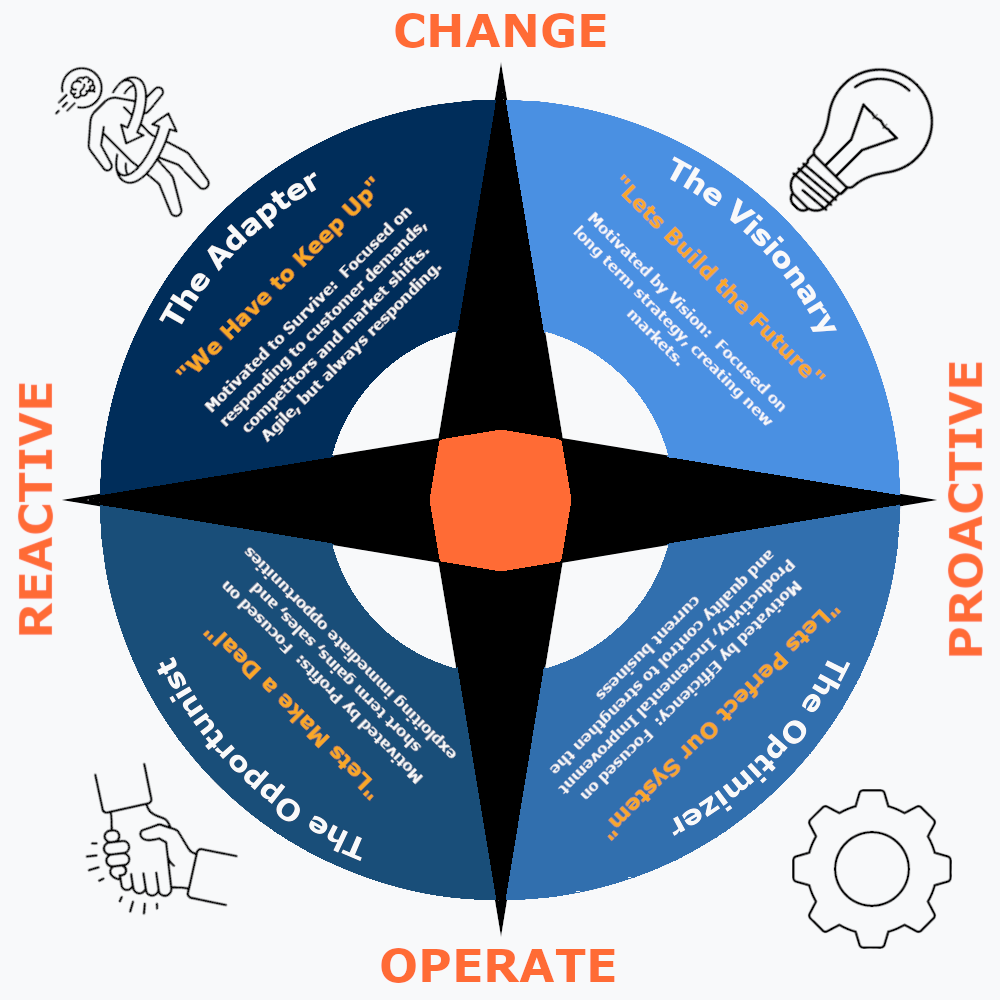
To solve this, I’ve developed the Culture Compass™, a framework to help companies navigate this exact dynamic.
The Principles of the Compass
The framework is grounded in a few simple but powerful principles:
Culture is Bias: It's the set of behaviors an organization naturally biases toward without some other significant, persistent influence.
Culture is Not Monolithic: It exists at all levels—individual, team, and organization—and is rarely consistent across them.
The Landscape is Defined by Two Axes:
The Vertical Axis (Operate-to-Change): "Running something well" is a very different skill than "building something new."
The Horizontal Axis (Reactive-to-Proactive): "Being highly responsive" is a very different skill than "being highly anticipative."
The Quadrants are Personas: The four resulting quadrants define recognizable personas that can be applied at any level.
Jumping is Dangerous: It's possible to stretch a culture to an adjacent quadrant. It is highly risky and improbable to "jump" across the map.
The Four Cultural Personas
These four personas should be relatable. Where does your team live?
The Opportunist
Motto: "Let's Make a Deal"
Description: This persona operates reactively, motivated by short-term profits and focused on exploiting immediate sales opportunities. Their actions are centered on capturing immediate, tangible gains rather than a long-term plan.
Personality: They are energetic, charming, and highly transactional, often loving the "thrill of the chase" but lacking long-term focus.
Example: Groupon during its high-growth phase, which was motivated by rapidly expanding into any new market and "deal" category to capture immediate revenue.
The Optimizer
Motto: "Let's Perfect Our System"
Description: This persona proactively operates to perfect the current business. They are motivated by efficiency, focusing on incremental improvements, productivity, and quality control to strengthen and defend their existing market position.
Personality: This persona is methodical, data-driven, and disciplined, valuing predictability and deeply disliking waste or chaos.
Example: McDonald's, which has built a global empire by relentlessly optimizing its processes for speed, cost-control, and consistency.
The Adapter
Motto: "We Have to Keep Up"
Description: Living by a reactive motto, this persona is forced to change. They are motivated by survival, focusing on responding to customer demands, competitors, and market shifts. Their stance is agile but perpetually defensive.
Personality: This persona feels hurried, stressed, and perpetually "on its heels," valuing flexibility and speed over long-term planning.
Example: BlackBerry (in its later years), which frantically launched new touch-screen models in a defensive, reactive attempt to "keep up" with the iPhone.
The Visionary
Motto: "Let's Build the Future"
Description: This persona proactively seeks change. They are motivated by a long-term strategic vision to innovate and create entirely new markets, focusing on what could be, well beyond the current state of the industry.
Personality: They are inspiring and risk-tolerant, often appearing restless and undeterred by the ambiguity of the unknown.
Example: SpaceX, which is driven by a mission to make humanity multi-planetary, fundamentally creating a new market.
The "Quadrant Jump": Why Most Strategies Fail
Here is the central challenge: most compelling growth strategies are grounded in "Visionary" language. But the organization's dominant culture is often "Opportunist" or "Optimizer."
The strategy plan includes an unstated, invisible assumption: that the organization can jump directly from "Opportunist" to "Visionary."
According to the Culture Compass™, this jump is not just difficult; it's a recipe for failure. The cultural DNA is too different. The strategy should instead be a deliberate, two-step plan to move through an adjacent quadrant.
No company illustrates this successful journey better than Amazon.
Case Study: How Amazon Navigated the Compass
Amazon didn't just become a Visionary. It earned the right to be one by mastering the other quadrants first.
Starting Point: The Opportunist
In the mid-1990s, Amazon's strategy was "Get Big Fast." Their early growth was purely Opportunistic, reactively adding any product category they could—CDs, videos, electronics, toys. This phase was energetic, transactional, and focused on grabbing immediate market share.
The Transition: The Optimizer
To survive this chaotic growth, Amazon was forced to become the world's most disciplined Optimizer. Jeff Bezos's legendary obsession with data and efficiency is a perfect "Let's Perfect Our System" mindset. They proactively built world-class fulfillment centers, a frictionless "1-Click" checkout, and a powerful recommendation engine. This intense focus on optimizing their operations built an indestructible, efficient core business.
The Destination: The Visionary
Amazon became a Visionary only after it had mastered being an Optimizer. In the mid-2000s, they realized their optimized internal infrastructure was a product in itself. They launched Amazon Web Services (AWS), effectively inventing the modern cloud computing industry.
In short, Amazon used "Opportunist" energy to start, became a world-class "Optimizer" to build a stable platform, and then leveraged that platform to become a "Visionary."
What This Means For You
That 70% failure rate isn't inevitable. It's often a simple failure of diagnosis.
Stop and look at your new strategic plan. Then look at your team. Does your "Visionary" strategy assume you can magically transform your "Opportunist" culture overnight?
If it does, you're not planning for a strategy; you're planning for a miracle. A better plan is to ask: "What's the first move? How do we become an 'Optimizer' first?"
So, where does your organization live on the Culture Compass? And more importantly, where does your strategy really need you to be? I’d be very interested in hearing your thoughts as to the relevance and usefulness of this framework, including your successes and “learning opportunities” so please share away in the comments or email me directly at david.leblanc@scappare-ventures.com.
