
The "Great Compression" is here - It took business 16 years to adopt the personal computer...AI tools will be adopted in less than 3!
The famous management theorist Peter Drucker once said “The enterprise that does not innovate ages and declines, and in a period of rapid change such as the present, the decline will be fast”. The challenging sub-text to this thought is that as much as its true today…it becomes progressively MORE true as time passes. It's a fundamental truth that the pace of change only accelerates!
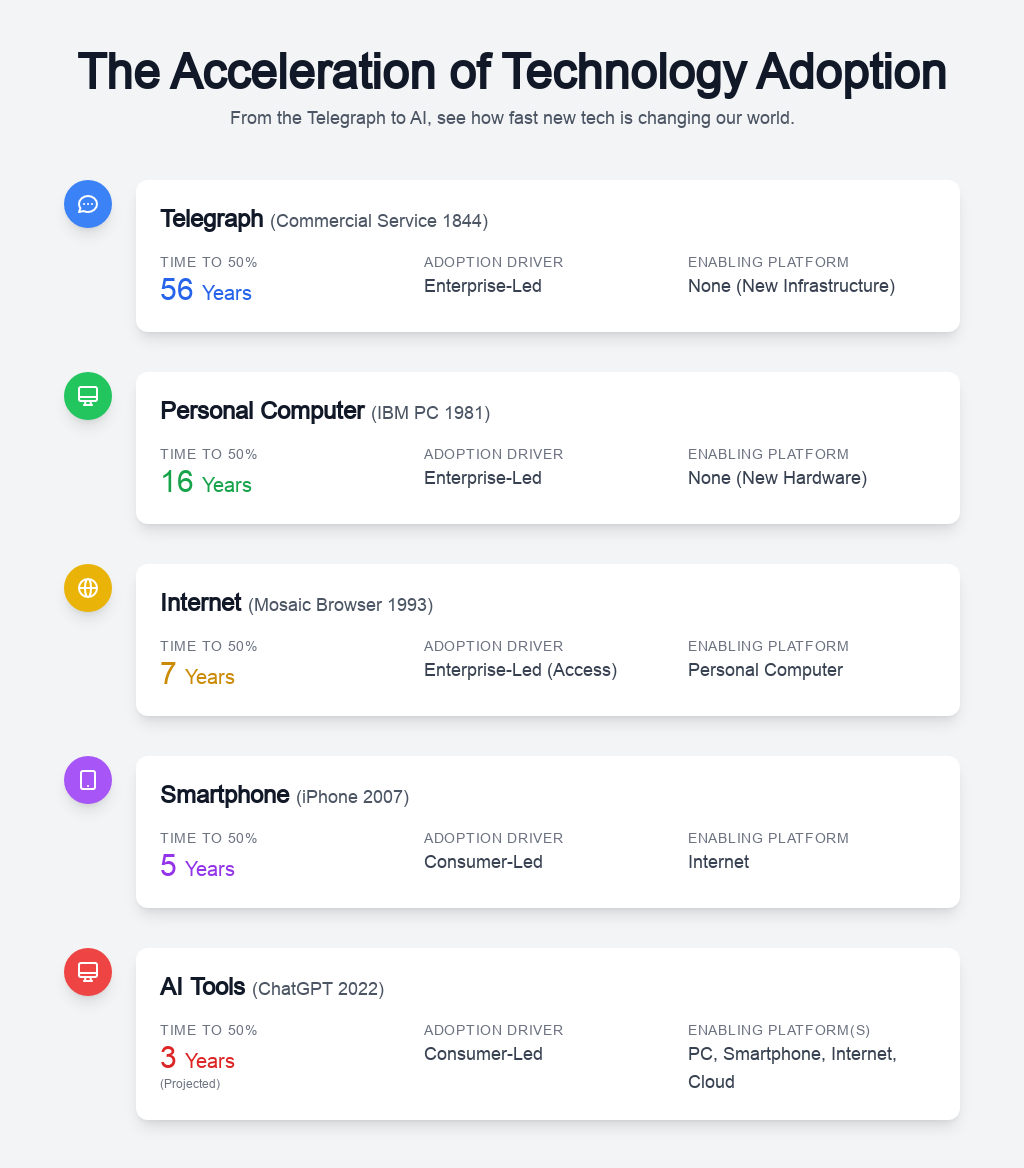
Roughly speaking, the adoption timeline for each broadly disruptive business technology has been 2x faster every cycle. Estimating the time for these foundational technologies to reach a 50% commercial/industrial adoption rate it took….
56 years to adopt the Telegraph
16 years to adopt the Personal Computer
7 years to adopt the Internet
5 years to adopt the smartphone
3 years (projected) to adopt AI Tools
While all business leaders inherently understand this continuous acceleration, what is more interesting is the difference in drivers and deployment models. The first two technologies required massive construction of infrastructure and/or capital expenditures to become viable. For example, IBM drove the cost of a desktop PC down to thousands of dollars, but it still required companies to make large capital investment decisions before the business PC became ubiquitous.
Compare that to smartphones. Those of you old enough to remember how quickly the blackberry was replaced by the iPhone will also remember that the iPhone was launched as a consumer device. In fact, personal adoption of iPhone was the major catalyst that drove business adoption, and the investment was minor relative to the incumbent technology. This represented the first major shift to a “bottoms up” driver of business technology adoption.
The adoption of AI tools represents a massive acceleration of this trend. Today, employees can make a unilateral decision to begin using AI tools as part of their personal and professional life with virtually no investment by either the employee or the business. While businesses can and should attempt to implement policies and controls to maximize the advantages of AI tool use while minimizing risks, they should also recognize that even the most robust governance model will not withstand the preferences of the broader employee population.
So what is a company to do in an environment where transformation technologies have moved from “driven by large capital investment decisions from the top” to “independently adopted from the bottom”. In short, companies must embrace a new default state of continuous adaptation. Organizational velocity - the ability to learn, test, deploy and scale new business operating models at speed is now the single most important competitive advantage. The “Industrial AI” era should not be thought of as next generation technology adoption, but as fundamental enterprise transformation that will quickly reshape all aspects of businesses. Those organizations that can proactively adapt to this new paradigm will succeed and thrive, those that lag…even a little…run the risk of “declining fast”.
As we launch Scappare Ventures, we are looking for leaders and partners who understand that Organizational Velocity is now the single most important KPI.
How is your team measuring velocity today?
#ScappareVentures #FutureOfWork #AIStrategy #BusinessTransformation #Leadership
